
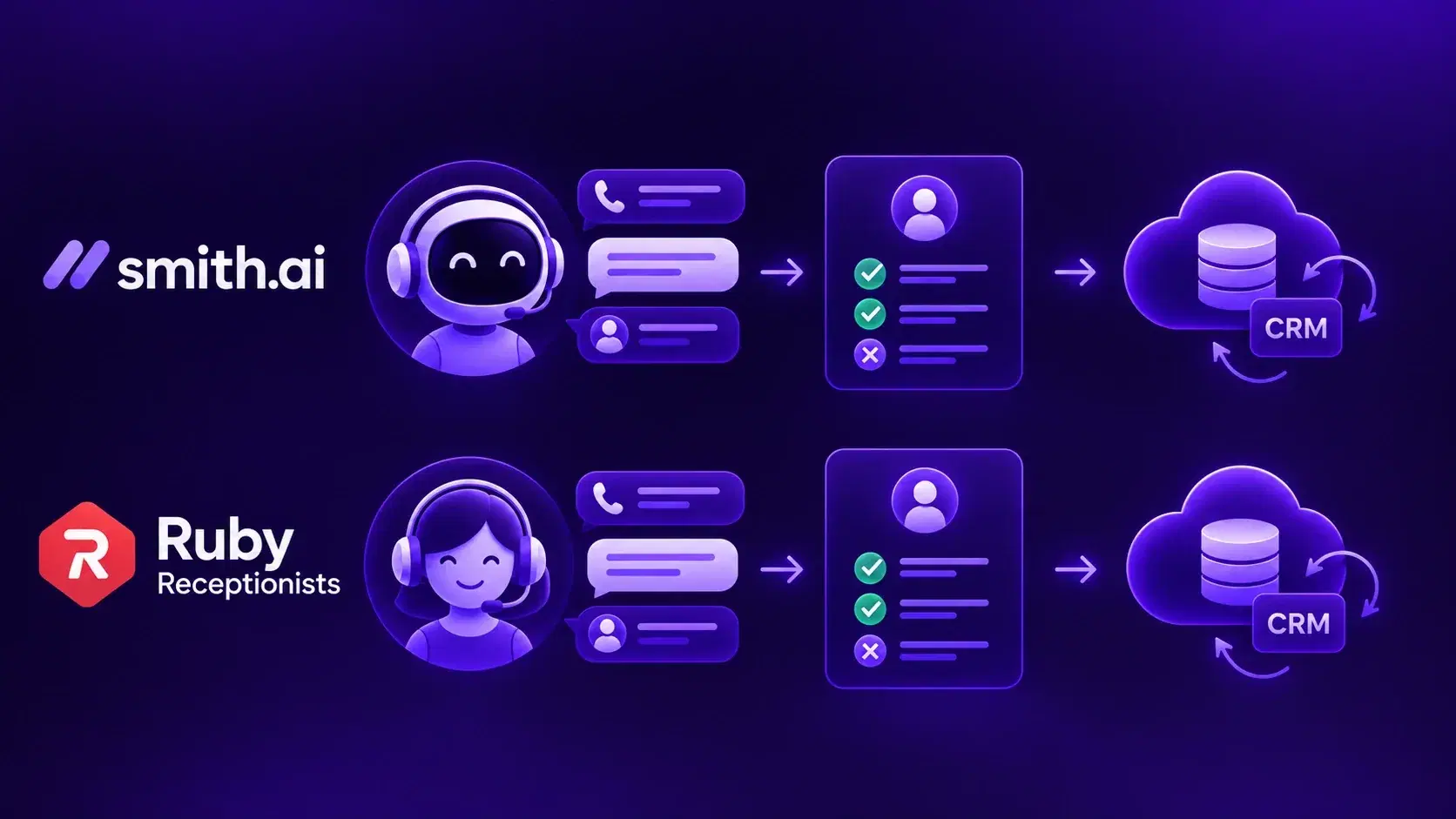
A customer calls while your team is helping someone else, and nobody picks up. Many of those callers move on to the next business in their search results. Smith.ai and Ruby Receptionists both address that gap with live receptionists who answer your business line around the clock.
The two services differ in how they bill, what they charge extra for, and how much help they give with intake and follow-up. This guide compares Smith.ai Virtual Receptionists and Ruby on price, billing rules, legal intake, integrations, outbound calling, and AI options, so you can match a service to your call volume and average call length.
Which is better, Smith.ai or Ruby?
Smith.ai suits businesses with longer calls and intake-heavy conversations, and Ruby suits businesses with short, simple calls and a lower monthly budget. Both services answer calls with live receptionists 24 hours a day, so the decision rests on billing, features and workflow.
Ruby has the lower entry price at $250 per month for 50 minutes, compared with $300 per month for 30 calls at Smith.ai. Cost per call depends on how long each call lasts, and the pricing section below shows where the two services cross over. Law firms get extra detail in the legal intake section.
Businesses whose main goal is automating repetitive questions can also consider an AI agent such as Chatley AI, covered near the end of this guide.
Smith.ai and Ruby at a glance
The table summarizes published plan details that independent trackers last verified in September 2026. Vendors change prices often, so confirm current rates before you buy.
Factor | Smith.ai Virtual Receptionists | Ruby Receptionists |
Entry price | $300 per month for 30 calls | $250 per month for 50 minutes |
Billing unit | Per call, $7 to $10 inside a plan | Per receptionist minute, $3.45 to $5.00 inside a plan |
Larger plans | $810 for 90 calls, $2,100 for 300 calls | $395 for 100 minutes, $720 for 200 minutes, $1,725 for 500 minutes |
Overage | $8.50 to $11.50 per call | Per-minute overage, billed above the plan allowance |
Answering hours | 24/7/365 | 24/7/365 |
Outbound calling | Offered, with a business caller ID add-on at $10 per month | Weekdays 5am to 6pm Pacific, billed in receptionist minutes |
AI role | Separate AI-first plans, with human escalation at $3 per call | Human receptionists, with AI used for transcripts and sentiment analysis |
Contract terms | Month-to-month, 30-day money-back guarantee | Minutes do not roll over between billing periods |
Smith.ai figures come from its published plans as recorded by Macha and Quo. Ruby figures come from Macha and CloudTalk, with plan tiers confirmed on Ruby's billing help center.
How much do Smith.ai and Ruby cost?
Smith.ai costs $300 to $2,100 per month for 30 to 300 calls, and Ruby costs $250 to $1,725 per month for 50 to 500 minutes on its four main plans.
Smith.ai's human receptionist plans bill per call. The Starter, Basic and Pro plans cost $300, $810 and $2,100 and include 30, 90 and 300 calls, which works out to $10, $9 and $7 per call. Calls above the limit cost $11.50, $10.50, and $8.50 each, and a plan change applies from the following month.
Ruby bills per receptionist minute. Its plans cost $250 for 50 minutes, $395 for 100, $720 for 200, and $1,725 for 500, or $5.00, $3.95, $3.60, and $3.45 per included minute. Ruby's help center lists larger tiers up to 2,500 minutes for busier lines.
Which costs less per call?
Ruby costs less per call when calls use fewer than about 2 to 3 billable minutes, and Smith.ai costs less when calls run longer. The break-even point comes from dividing Smith.ai's $7 to $10 per-call price by Ruby's $3.45 to $5.00 per-minute rate.
Take a 3-minute call. On Ruby's 500-minute plan it uses about $10.35 of included time, and on the 50-minute plan it uses $15.00. Smith.ai charges $7 to $10 for the same call. The 50-minute Ruby plan covers about 16 such calls, while the $300 Smith.ai Starter plan covers 30.
An analysis by Macha modeled 200 calls a month averaging 2.5 minutes. Ruby's 500-minute plan came to $1,725, and Smith.ai's Basic plan plus 110 overage calls came to $1,965. At that call length the two services sit close together, so measure your own average before you compare.
What billing rules change the final bill?
Hold time, call wrap-up, spam handling and add-ons can change the final bill noticeably, and the two services treat each one differently.
Hold time and wrap-up. Ruby counts receptionist minutes from the moment a receptionist receives the call, including hold time and the time spent completing call details after the caller hangs up, according to Ruby's billing basics. Smith.ai charges one per-call fee, so hold time does not add to the bill.
Rounding and short calls. Ruby does not bill calls under 10 seconds. Its help pages describe rounding up to the next 60 seconds, while its FAQ and terms describe 30-second increments, so ask which rule applies to your account.
Spam and wrong numbers. Smith.ai says its human plans do not charge for spam or unsolicited sales calls when your forwarded line passes caller ID. Ruby filters robocalls, and any call that reaches a receptionist uses minutes.
Add-ons. Smith.ai add-ons apply per call across all calls in the month. Appointment booking costs $1.50 per call, so a 90-call month adds $135, and call recording costs $0.25 per call.
Unused allowance. Ruby minutes do not roll over to the next billing period. Smith.ai human plans are month-to-month with a 30-day money-back guarantee capped at $1,000.
Which service suits law firms and software integrations?
Smith.ai has the more documented legal intake offering, and Ruby also connects to major legal software. Smith.ai lists intake form completion, lead qualification and conflict checks for law firms. Its integrations include Clio, MyCase, PracticePanther, Lawmatics and Calendly, plus thousands more through Zapier and Make, according to its Clutch profile. Lawyerist notes that Smith.ai serves many industries and has a long history with law firms.
Ruby's integrations reach Clio, Filevine, Lawmatics, Law Ruler, Rocket Matter and MyCase, plus Zapier, according to a Dupple review. For a law firm, the larger difference lies in pricing mechanics. Smith.ai charges $0.50 per call for conflict checks and each extra CRM connection. Ruby includes its features in the plan, but a long intake interview uses more minutes.
Firms with detailed intake scripts should time a sample call and check each vendor's current integration list against their practice management software before comparing prices.
How do outbound calls compare?
Ruby makes outbound calls on weekdays from 5am to 6pm Pacific, and Smith.ai offers outbound calling with its own per-call pricing. Ruby's FAQ lists appointment reminder calls and passing information to clients as typical uses. Ruby bills the specialist's time on the call plus the time spent emailing you the result.
Here is a worked example. A clinic asks Ruby to place 40 reminder calls that each last 1 minute. The calls alone use 40 minutes, and the follow-up emails add more, so most of a 50-minute plan disappears on one task. The same 40 calls on a per-call plan count as 40 calls against the monthly allowance.
Smith.ai sells business caller ID for outbound calls at $10 per month, which lets customers see your own number. Ask Smith.ai to confirm outbound hours in writing if you need callbacks in the evening or on weekends.
Where does AI fit next to human receptionists?
Smith.ai sells AI receptionist plans alongside its human service, and Ruby keeps live receptionists on every call. Smith.ai's AI-first plans start free for 25 calls a month, with human escalation at $3 per call. Ruby's AI appears in call transcripts and sentiment analysis, and receptionists still answer the phone.
Chatley AI is a separate option for businesses that want an AI customer service agent. It answers from a business's own knowledge base, including policies, FAQs and product information, and keeps the same knowledge and conversation record across phone, chat and SMS. It can look up order and appointment details and resolve routine requests around the clock.
When a call needs a person, Chatley AI transfers it to a human with a conversation summary, and the business sets when transfers happen. Coverage is configurable, so the agent can answer only after hours, only when lines are busy or all the time. Setup takes minutes, a free trial is available, and callers speak with an AI agent, so businesses that need a person on every call should choose Smith.ai or Ruby.
How to choose between Smith.ai and Ruby
Follow these steps to match a service to your call pattern.
Pull 3 months of call logs and count total calls per month and the average length in minutes.
Price both services at that volume, using per-call rates for Smith.ai and billable minutes for Ruby, and add hold time and wrap-up to the Ruby estimate.
List the software that needs intake data, such as Clio, Lawmatics or a CRM, and check each vendor's current integration list.
Decide whether you need outbound calls, and note the hours each service covers.
Ask each vendor in writing about overage rates, spam handling, rounding rules and add-ons before signing.
Conclusion
Choose Smith.ai when calls run longer than about 3 minutes, intake needs structure, or a law firm needs conflict checks and practice management syncing. Choose Ruby when calls are short, volume is low, and a $250 entry plan fits the budget. Both give you a live person on the line at any hour.
Your next step is to count last quarter's calls and average minutes, then price both services against those numbers. If most of those calls are repetitive questions, try Chatley AI's free trial to see how automated answering handles them.